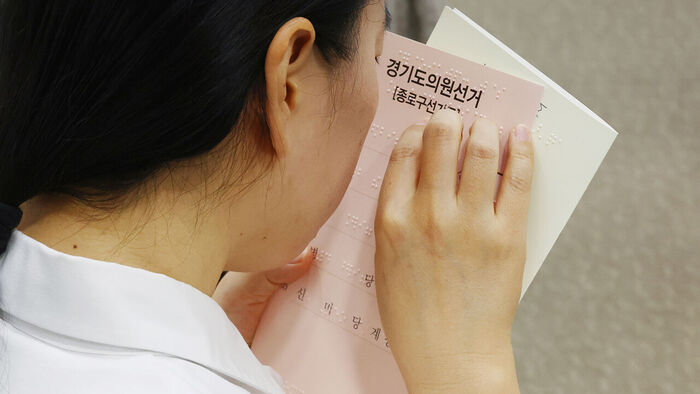
▲ An attendee examines a Braille ballot during a mock early voting session for the 9th Nationwide Simultaneous Local Elections, held ahead of a policy seminar on guaranteeing voting rights for disabled voters at the Irum Center in Yeongdeungpo-gu, Seoul, on the afternoon of April 10.
It was confirmed today (June 19) that significant confusion occurred during the June 3 local elections regarding voting for the elderly and people with disabilities, in addition to the unprecedented shortage of ballots.
While there is a separate "Voting Management Manual" for voters with disabilities and the elderly, training for on-site election staff is conducted by local election commissions in each district, city, and county. Because there is no oversight procedure by the National Election Commission (NEC), the level of familiarity with the manual varied greatly from one polling station to another.
According to data submitted by the NEC to the offices of People Power Party lawmakers Joo Jin-woo and Kim Ye-jin, there were numerous cases where confusion arose due to a lack of familiarity with guidelines and poor responses when managing voting for the disabled and elderly.
The NEC manual includes instructions on how to assist disabled and elderly voters, provide voting assistance and convenience items, use Braille voting aids for the visually impaired, and use specialized marking tools.
However, according to voting records from the 8th polling station in Segok-dong, Gangnam-gu, obtained by Rep. Joo, a visually impaired couple arrived to vote, but the Braille voting aid was printed incorrectly, forcing them into a situation where they had to rely on the assistance of a poll worker.
One of the spouses, distrusting the poll worker's assistance, called an acquaintance to enter the voting booth together. The situation was only resolved after an uncertain on-site official consulted with the NEC and received confirmation that the vote would be considered valid.
At the 4th polling station in Suseo-dong, Gangnam-gu, a visually impaired voter reported that the Braille aid for "Gangnam-gu" was incorrectly labeled as "Gangbuk-gu," and the incident was reported to the election commission.
Data on "Status of Complaints from Visually Impaired Voters" obtained by Rep. Kim also confirmed cases such as Braille printing errors on aids for the Seoul Superintendent of Education election, printing errors for the Gangnam-gu 4th constituency, production errors on aids for the Ulsan Superintendent of Education election, and typos in Braille on voting aids in Daejeon.
In Sejong, there was a case where instructions on the voting assistance system were given to a companion rather than the voter, and in Gyeonggi-do, there was a case where a voter visiting an early voting station was incorrectly guided toward the mail-in voting system.
At the 7th polling station in Jangji-dong, Songpa-gu, a son attempted to assist his visually impaired elderly mother in voting, but the on-site staff could not respond immediately and failed to reach the Songpa-gu Election Commission for guidance.
The vote was only cast with the son's assistance after contacting the National Election Commission.
At the 3rd polling station in Naegok-dong, Seocho-gu, an elderly mother and her son attempted to enter the voting booth together. Staff explained that unless there was a physical disability, they could not enter together based on a lack of education. The son expressed strong dissatisfaction, stating that the family had been voting together for 10 years, and they left after only casting a partial vote.
After the son realized the ballot was processed as invalid and complained to the election commission, they were allowed to return and re-vote.
At the 6th polling station in Jamsil 3-dong, Songpa-gu, it was recorded that a wheelchair user and their assistant received the first ballot together, but only the wheelchair user received the second ballot; there was no report on how this was subsequently handled.
Rep. Kim stated, "We must completely overhaul the NEC's incompetent system, which fails to perform even basic inspections. We need to meticulously redesign the human and material infrastructure from the ground up so that voters with disabilities can vote without any barriers, on an equal footing with non-disabled voters."
(Photo: Yonhap News)
※ Please note: This article was translated by AI and may contain errors.